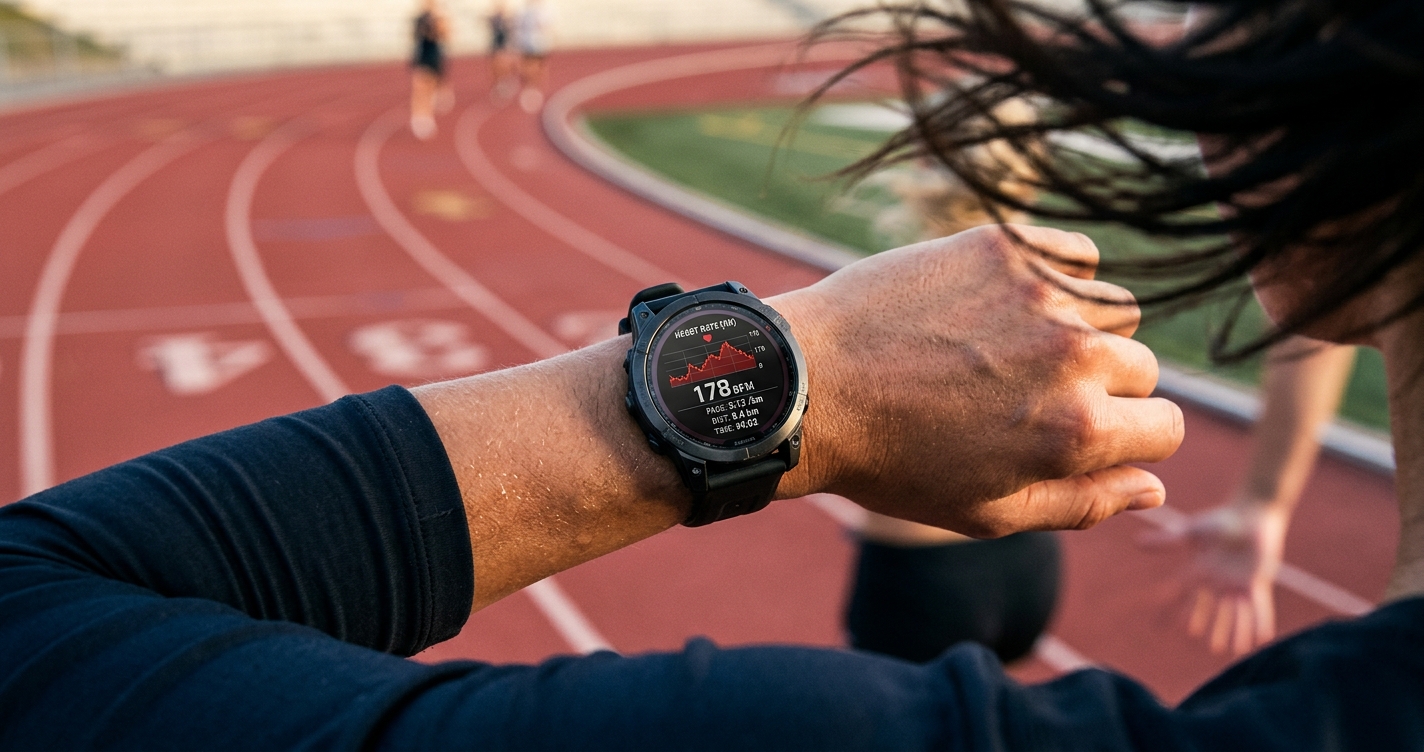
Heart rate training is one of the most powerful tools available to modern runners — yet most runners either ignore it entirely or use it incorrectly. Training by heart rate takes the guesswork out of effort, ensures your easy days are truly easy, and helps you hit the right intensity on hard days. Once you understand your zones, you'll never look at pace the same way again.
Why Heart Rate Beats Pace
Pace tells you how fast you're going. Heart rate tells you how hard your body is working. These are not the same thing.
Consider this: on a hot UAE morning at 35°C, your heart rate at a given pace will be 10–20 beats higher than the same pace in cool conditions. If you're chasing a pace target on a hot day, you'll run significantly harder than intended — accumulating fatigue you didn't plan for. Train by effort (heart rate), not pace, and your training is calibrated to your physiology, not to external conditions.
Estimating Your Maximum Heart Rate
Everything in heart rate training is based on your maximum heart rate (HR Max). The common formula — 220 minus age — is a population average with large individual variation. A 35-year-old could have an HR Max anywhere from 165 to 195.
Better methods to estimate your HR Max:
- Field test: After a thorough warm-up, run 3 minutes hard, then 30 seconds all-out sprint. The heart rate at the very end should be near your maximum.
- Race data: If you've raced a 5km recently and ran it hard, your peak heart rate during the last 400m is close to your maximum.
- Lab test: A VO2max test at a sports lab gives the most accurate measurement.
The Five Heart Rate Training Zones
Zone 1 — Recovery (50–60% HR Max)
- Very easy, effortless running. Conversation is easy.
- Purpose: Active recovery, warm-up, cool-down
- Feel: You could run for hours like this
Zone 2 — Aerobic / Easy (61–70% HR Max)
- Comfortable aerobic running. Can hold full sentences.
- Purpose: Aerobic base building — the most important zone for endurance runners
- Feel: Relaxed, sustainable for hours. Many runners go too fast here without realizing it.
Zone 3 — Tempo / Threshold (71–80% HR Max)
- "Comfortably hard." Short sentences possible but conversation is labored.
- Purpose: Lactate threshold development
- Feel: The effort you can sustain for about 60 minutes in a race
Zone 4 — Interval (81–90% HR Max)
- Hard. Only a few words possible. Breathing is heavy.
- Purpose: VO2max development, running economy
- Feel: The intensity of a 5km–10km race effort
Zone 5 — Maximum (91–100% HR Max)
- All-out. Cannot speak. Only sustainable for seconds to 2–3 minutes.
- Purpose: Speed development, neuromuscular power
- Feel: Last 400m of a race when you're giving everything
How to Structure Training by Zone
For most runners, the optimal training distribution follows the 80/20 principle:
- ~80% of training time in Zones 1–2: This feels embarrassingly easy for many runners. That's correct — it's supposed to.
- ~20% in Zones 3–5: This is where quality work happens — tempos, intervals, race-specific training.
Most recreational runners accidentally train in Zone 3 — moderate effort — for most of their runs. This is the "grey zone": too hard to be truly aerobic, too easy to produce the adaptations of Zone 4–5. The result is chronic tiredness, plateaued performance, and often injury.
Heart Rate Training in UAE Heat
Heart rate training becomes especially valuable in UAE conditions:
- On a 38°C morning, your heart rate will be 10–20 bpm higher at the same pace as in cool weather. Running to a pace target means you're working in Zone 3–4 when you intended Zone 2.
- Use your Zone 2 heart rate ceiling (typically ~70% of HR Max) as your ceiling for easy runs. Let pace be whatever it needs to be — sometimes 7:00–7:30/km in extreme heat. This is not slow; this is correct.
- As you acclimatize to UAE heat over 10–14 days, your heart rate at the same effort will drop. You'll be able to run faster at the same heart rate — proof that your fitness is improving even in the heat.
Practical Tips for Using a Heart Rate Monitor
- Chest strap vs. wrist: Chest straps are significantly more accurate, especially during high-intensity efforts. Wrist-based monitors are convenient but lag behind real intensity changes.
- Don't obsess: Heart rate is a guide, not a ruler. It fluctuates based on hydration, caffeine, sleep, stress, and heat. Use it as context, not as absolute truth.
- Log your data: Over weeks and months, patterns in your heart rate data reveal your fitness progression — even if pace targets don't show improvement yet.
"The runner who understands their heart rate zones has a competitive advantage over almost every runner who trains purely by feel or pace. Precision produces results."
Train With Precision Under Expert Guidance
Coach Noaman's programs include heart rate zone guidelines and effort-based targets calibrated to UAE conditions and your fitness level.
View Programs Ask Noaman